Journal Kurdish Academy

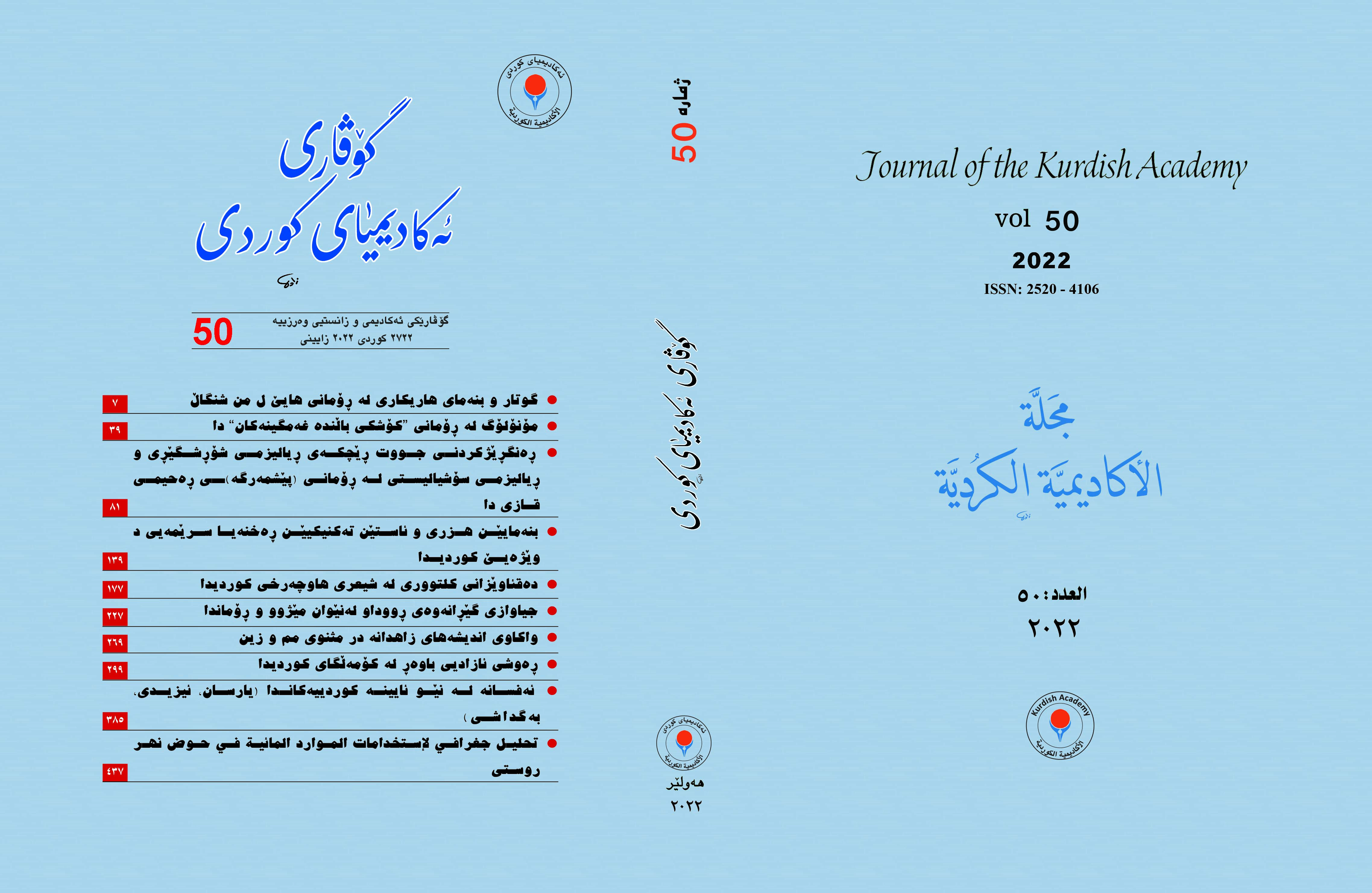
Journal of the Kurdish Academy

Vol. 0, No. 50 (2022)

Journal of the Kurdish Academy

12 March 2022 · 10 articles

Proceedings of
Advanced Knowledge

A geographical analysis of water resource uses in Roste Watershed

محمد حمە صالح فارس, ئوميد حمه باقى حمه امين

The study area is located in Erbil Governorate, specifically in the north-east of the governorate of Erbil, between two latitudes (°36:36'50" - °36:45'10") North and both longitudes (°44:38'30" -°44:50'33") East. The area of ​​the basin is (163.7) km2. Administratively, the basin is located in the Similan sub-district of Choman district in Erbil governorate. This study aims to make a balance between the available and consumed water to determine the amount of the water surplus or deficit in the region. Whether it is surface water such as a river or groundwater such as wells and springs, to know the amount of water available in the study area, Then the types of uses of water resources represented in domestic, agricultural, and animal use were searched, then analyzed and the amount of water required for each of them was determined according to scientific standards. Finally, the research ended with conducting a water balancing process between the amount of available water (67911900) million m 3/year and the amount of consumed water(36451652,75) million m3/year. It turns out that the amount of available water exceeds the amount of water consumed. Fortunately, there is a large surplus in the amount of water, where the surplus amounted to (31460247.25) million m3/year.

Proceedings of
Advanced Knowledge

A monologue in the novel "The Palace of Sad Birds" from the perspective of psychological criticism

رێبوار محەمەد ئیسماعیل

This study, which is entitled (The Palace of Sad Birds) by Bekhtiar Ali, is a technical study of monolog in the novel from the perspective of a psychological critical approach.

In general, this study referred to the monologue technique in the novel. Later, in another section a glance is given to some general and theoretical aspects of this art from the psychoanalytic perspective as. This art has been analyzed and evaluated on the basis of one's personal Angle structure. Then this study has examined the practical aspect of the Palace of Sad Bird novel in this section depending on the psychological factors of monologue making exhibited and psychoanalyzed by the characters.

Proceedings of
Advanced Knowledge

Different narrations of events between history and novel for example the (peshmarga) novel by Rahim Qadhi

یووسف عەلی محەمەد

The shared point between history and novel is generally narrating, but there is a difference in the method and style of narrating. History narrates a number of actual incidents that took place in the past and archive them as documents for the next generations. While novel as a modern genre makes use of actual present or past incidents and remake them again. i.e. novel doesn't pass the incident as it is but it also modifies it. This resulted in a type of novel which is historical novel. This type of novel makes use of historical events and figures in order to present sights of the era.


This study (Different narrations of events between history and novel) tries to marginalize this difference which occurs in the style of narration. The (Peshmarga) a novel by Dr. Rahim Kazi has been chosen as a sample for this purpose. The research is composed of two parts. The first one is theoretical and an attempt to work on terminologies like history, novel, and historical novel which is presented in three sections. The second part is practical and composed of two sections. The first section is working on the relationship between an event and other aspects of novel like setting,  character, and etc... The second section is working on the technical roles of novel in making the historical events in the novel into art. Finally, the result of the research is presented in a number of points with putting the list of references in Harvard style.

Proceedings of
Advanced Knowledge

Technical foundations and cognitive levels of impressionistic criticism in Kurdish literature

ئەحمەد محەمەد مام عوسمان قەرەنی,

The research deals with the effect of artistic taste for literary works and the resulting critical observations of the reader. And what is based on that taste of fleeting impressions and conclusions from the sustainable accumulation of knowledge of the critic what he explores artistically in the expressions of that structure of meanings that it is difficult for the amateur reader to comprehend adequately without relying on what is presented to him in his deconstruction of the text and analysis of its components linguistically then structuring his critical subject that serves as a guide to the poet and the deducting assistant to the recipient at the same time.

The research consists of two parts: the first section is concerned with the theoretical side of the subject, and provides a full definition of the term impressionistic criticism, its concept components, its position in the critical discourse, its features at the levels of the readable text, its linguistic and artistic meanings, and then its direct relationship with the recipient.

In the second section, the researcher tried to apply what was concluded in the first section to one of the critical texts published within the contents of the book (Voices and Stumblings - Critical Readings) as a model for impressionistic criticism in Kurdish literature with a detailed explanation of its three levels in terms of dealing with the poetic text and dissecting the implications of its expressions in its deviation and syntax. Syntax, as well as methods of addressing conceptual communication between the poet as the creator of the text and the recipient as its reader.

Proceedings of
Advanced Knowledge

The legend in the Kurdish religions (Yarsani, Yazidi, Bektashi)

سازان سەباح پیرباڵ, زریان جیژنی محەمەد,

It is difficult to determine the first beginnings of the myth, but we know that the myth in the early stages of human life and until the present time was not far from the awareness and imagination, and that the emergence of religious beliefs was the result of human weakness in front of the cruelty of nature, and the myth is a necessary thinking among religions or religious groups to perform Functions or to answer questions of anthropology, and myth does not require deep thought or it is not a necessary scientific theory.

When you read any story of these religions, its cornerstone is a mythical story, and when you search for its history and elements (Yazidism, Kaka’i and Bakdashian), it is basically made up of a group of non-Semitic religions, and they are of Aryan origins, and they have characteristics that return them to the Zakros region, influenced by one another. And there are similarities between them in terms of folklore, intellectual and belief, and even in their legends. At the same time, the character of nomadism throughout their long history has caused some differences in their beliefs, but mainly they believe in oneness.

The legend is a historical story, but it is not an ordinary story, but rather it has a sacred history and is of special importance for the formation of a special folklore for all generations, for this we can say that the religious legend (is a group of creations made by human thought and continues to develop until it turns into a set of constitutions aimed at rationalizing society). Self-reverence is an unnatural characteristic of these religions, which gives them an unnatural power and a sacred status. In addition, some of these myths, and to this day, such as the sanctification of (land, water, and air (nature) appear clearly, and the sanctity of these elements is common among many Of the Aryan peoples, the Yazidis believe that) Sheikh Adi( lived during the time of Sultan Sahak, that is, in the period between the twelfth and thirteenth centuries, which is the period in which the) Bektash( lived and in which he founded his sect.

Proceedings of
Advanced Knowledge

The reality of the freedom of belief in the Kurdish society A field study in Erbil governorate

ئەسرین زرار قادر

The conflicting history of beliefs and religions, as well as the rejection of variations and attempts to impose the dominant religion, resulted in the development of the concept of religious freedom.

 Within the context of this principle, all differing beliefs have an equal right to the free exercise of their inherent nature and sanctity. The significance of stressing this topic is that legal acknowledgment of freedom of faith and religion in Kurdish society can be incorporated into the mindset and social morals of all different faiths. The research sought to explain the condition of religious freedom in Iraq and the Kurdistan Region by examining constitutional and legal requirements.

 This topic is analyzed via the lens of Bertrand Russell's ideological paradigm of freedom, religion, and rationality. One of the study's major findings is that the majority of religions adhere openly and in private to their faith's rites and ceremonies. While changing religion is not permitted by law. Under the Iraqi Personal Status Act, all religions and beliefs have marriage contracts, but the law's provisions are based on Islamic religious law, thus marriage between other religions is a religious barrier. While religious liberty is possible, it is not necessary, and legal acknowledgement of this subject has not resulted in social confession. Disbelievers are not protected legally or socially. The lack of awareness of the concept of religious freedom and opposition to differences, as well as the instability of the political situation, the neglect of the educational program, and the establishment and implementation of legislation, are the primary impediments to religious freedom.

Proceedings of
Advanced Knowledge

The Speech and Cooperative Principle in the novel “Haye Li Mn Shingal”

حاجى عەبدولڕەحمان حاجی, غازی حەسەن محێدین

The title of the research is (The Speech and Cooperative Principle) in the novel “Haye Li Mn Shingal”. The study is adescriptive pragmatic analysis (cooperative Principle) of (Grice) which is aims to identify the cooperative principles in novels. The framework is such that the examples are driven and analysed from the novel “Haye Li Mn Shingal”. In this research, direct speech is the main factor of analysis in the structure of the speech. Unlike the studies that have been carried out previously about speech, this one has focused on a different strategy, from social perspective, the aim of speech, its consequences, reproducing content on the basis of cooperative have worked on it, and this principle has impacts on the success of the communication process.

The study consists of two parts, the first part is the theoretical background that emphasizes speech, its analysis and content, with the consequences of speaking and cooperative principles and disobeying the principles with examples. The second part is the practical part of the research that emphasizes on principles of cooperative and disobeying the principles depending on the examples with in the novel “Haye Li Mn Shingal” and its analysis.

Proceedings of
Advanced Knowledge

Traditional Intertextuality in contemporary Kurdish poetry (Abdullah Pashew, Latif Helmet, Sherko Bekas) Examples

سروشت جەوهەر حەوێز

 Literature is a phenomenon that comes under direct and continuous influence of changes, and one of those phenomena that appeared affected by these changes is intertextuality. High-quality artistic, intertextuality searches for and shows the relationship of influence between literary texts with the intention of moving the literary aspects with an artistic sense of the texts transmitted by the writer, and shows the extent of his influence in the transfer and employment of those texts. Intertextuality in its beginnings appeared in Europe and later in the Middle East, specifically in Arabic literature, and then moved to Kurdish literature, so this term is considered modern in use in Kurdish literature, because it did not appear until after the uprising. Intertextuality shows the poet’s ingenuity in taking the original text and employing it in his works without the recipient directly feeling it. It is an attempt to read the poems of these poets and to show the phenomenon of intertextuality in their poems, specifically the traditional intertextuality by taking some poetic texts that specifically reflect the heritage intertextuality.In our research, we have taken the historical-analytical method, and the research includes the introduction, two main sections, conclusion, and a list of sources and references. In the second section, we talked about the traditional intertextuality in the poems of Abdullah Pashew, Latif Helmet, and Sherko Bekas in all kinds of influence under which the text came, including from heritage, epic, myth, proverbs, heritage stories and traditional folk ballad.

Proceedings of
Advanced Knowledge

Utilizing the dual path duality of revolutionary realism and the socialist realism in the (Peshmerga) novel by the novelist Rahimi Qazi

كارزان موحسين قارد,

This study entitled The “Utilizing the path duality of the revolutionary realism and the  socialist realism in the ( Peshmerga) novel by the novelist Rahimi Qazi”. aims to find a place for Revolutionary. Realism and Social Realism Models in Kurdish Literary Criticism. These two models have not been previously researched in relation with a Kurdish novel ; they have been briefly explained solely in theory . The current study is a new attempt focusing on literary theories and schools and linking them to a literary genre of, specifically the novel of Peshmarga

Proceedings of
Advanced Knowledge

واکاوی اندیشه‌های زاهدانه در مثنوی مم و زین

جیهاد شکری رشید,

  Asceticism is one of the important topics in the humanitarian folklore and especially in the literary and Islamic ideology. The origin of Khani’s Asceticism returns back to his gnostic doctrine. An accurate discussion of Khani’s mystic and ascetic behavior towards life clears all the vagueness of his personality, his ascetic behavior is not the only reason that made life valueless in his viewpoint but there are a lot of other scientific and religious reasons behind it, which will be discussed in a specific way in this research. Khani in expressing the ascetic connotation of his words he framed himself as well with it. The isolation of oneself and the abandon of people is one of the important elements of asceticism and this is shown in Mam’s speeches. The isolation of Mam was a reason for his mastership above the others. This research paper that prepared by using the descriptive- analytical method tries to answer the essential question that is ;what was the degree of  the similarity or difference in the ascetic core of Mam u Zin’s Mathnawi? In this way the internal ascetic psychology of the poet will be evaluated in his great Mathnawi Mam u Zin. From this point of view the researcher believes that Khani’s work to a degree is an ascetic text, so he tries to analyze the ascetic core of Mam u  Zin’s Mathnawi.