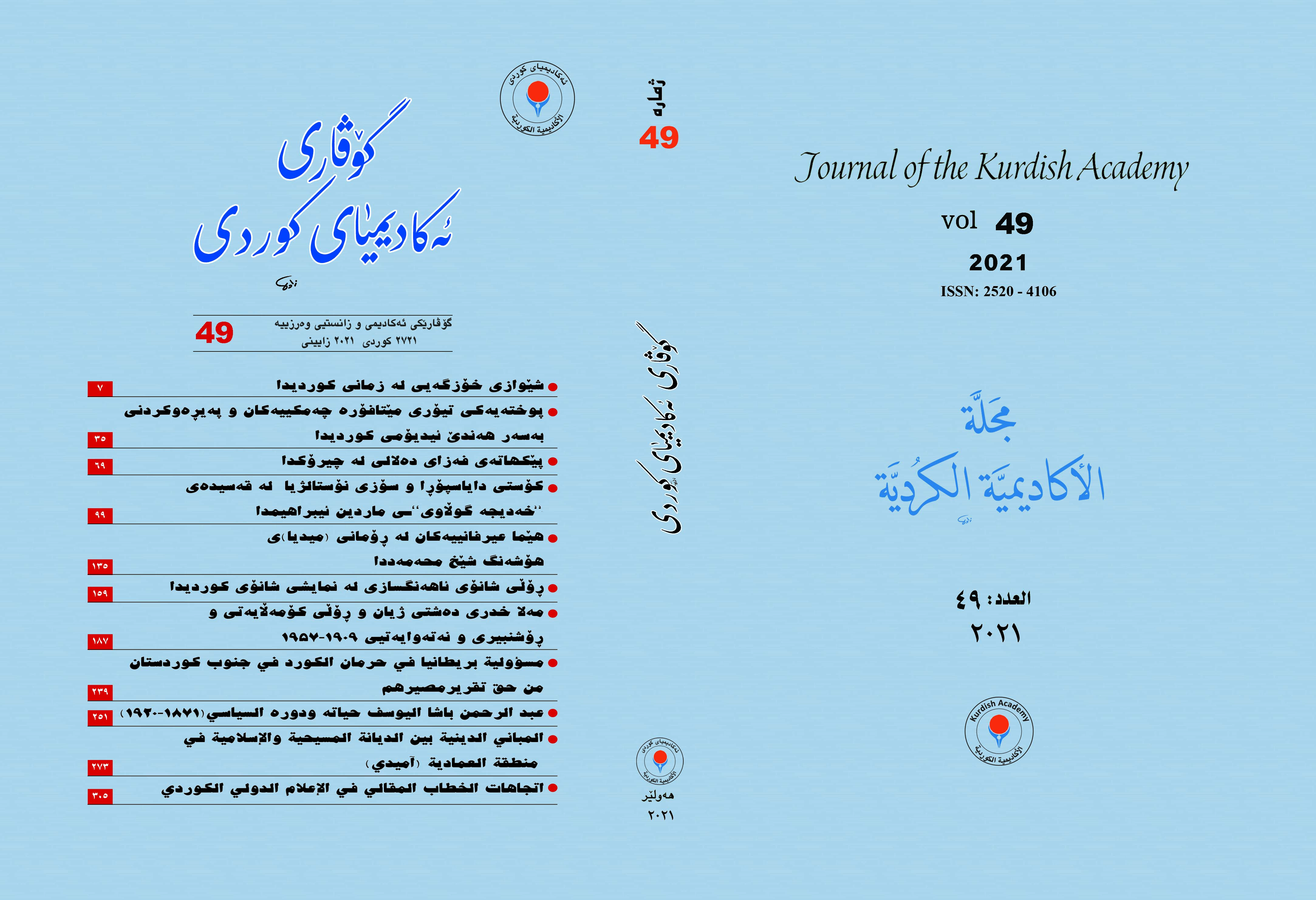
Journal Kurdish Academy

Journal of the Kurdish Academy

Vol. 0, No. 49 (2021)

Journal of the Kurdish Academy

15 December 2021 · 11 articles

Proceedings of
Advanced Knowledge

اتجاهات الخطاب المقالي في الإعلام الدولي الكوردي

هاوژين عمر محمد

The trend has a direct connection with human activities, and several fields of scientific studies, especially linguistic, media, political and social studies. The subject of the trend in the media and literary works is clearly manifested in novels, poems, news and articles, especially the press article, which is usually divided into a group of trends, through which researchers are able to monitor the trends and interests of media institutions on the one hand, and their influence on the recipient and his change of behavior, In the direction of changing or modifying old trends on the other hand, in order to serve the ideological references of writers, and the media policy of media institutions.The research addressed this issue by describing and analyzing the scientific phenomenon, using the discourse analysis method, for a sample of (47) political articles, which were published on the website of the Zagros satellite channel, in the last six months of 2019.It was found that the trends of the articles on the mentioned site were distributed among the Kurdish, Iraqi, and international trends, and each direction included a set of topics that in turn contained several ideas, noting that priority was given to the Kurdish trend over the other two directions.
It was also found that the site has a specific methodology in selecting and publishing articles, and that the contents and ideas of the speeches are consistent with the political vision of the Kurdistan Regional Government and some influential leaders. The book employed several methods that amounted to adapting the language used for ideological purposes linked to political references, and knowledge and intellectual backgrounds compatible with the interests of the communicator in the Zagros Media Foundation.

Proceedings of
Advanced Knowledge

المباني الدينية بين الديانة المسيحية والإسلامية في منطقة العمادية (آميدي) (نماذج مختارة)

زيدان رشيد خان اودل برادوستي, كوڤان احسان ياسين, يادكار محمد سليم محمدطاهر

The concept of religious architecture and the buildings is a part of the cultural heritage in the Amadiyah region, this heritage was mixed between Islamic and Christian religions. This research is a field study on some buildings and archaeological evidence, which are historical evidence for the content of the research. And that buildings need in-depth study and so that the details can be found to understand the historical progression in them. Some of them have remained in their original states and preserved their religious function, while others have changed their function with some minor changes in their architectural parts.

Proceedings of
Advanced Knowledge

پوختەیەکی تیۆری مێتافۆرە چەمکيیەکان و پەیڕەوکردنی بەسەر هەندێ ئیدیۆمی کوردیدا

هۆشه‌نگ فارووق جه‌واد

Idioms form the catalyst of every language since they carry more meanings in addition to their basic meanings. These additional meanings are the outcome of accumulated experience and daily interaction of humans with themselves and their surroundings. Moreover, idioms reflect geographical, religious and historical characteristics of humans as well as their patterns of thought and social relations.

Despite the fact that idioms have received special attention from linguists, traditional linguistics has only explored them from the syntactic, semantic and pragmatic aspects considering them mostly as being fixed and inseparable. Against this perspective, the cognitive theory takes a radically different view about idioms as it sees it as a conceptual metaphor and every instance of conceptual metaphor is accounted for in terms of a conceptual mapping between the source domain and a target domain.

The current study is made up of seven parts organized as follows:part one is an introduction to the theory of conceptual metaphor theory. Part two defines the concept of conceptual metaphor while part three deals with the experiential basis of conceptual metaphors. Part four discusses metaphorical mapping between source domain and target domain. Part five classifies the conceptual metaphors in the light of Lakoff and Johnson’s theory. Part six presents the application of the theory to Kurdish idioms while the final section summarizes the conclusions drawn from the study.

Some outstanding conclusions from the study include: traditional linguistics views idioms as words and as a linguistic phenomenon while cognitive linguistics views them as conceptual metaphors. Another point is that Kurdish idioms can also be classified into structural, ontological and orientational metaphors and that the same experiential and physical bases for metaphorical mappings can also be specified for the Kurdish idioms.

Proceedings of
Advanced Knowledge

پێکهاتەی فەزای دەلالی لە چیرۆکدا چیرۆکەکانی (سەدرەدین عارف) بە نموونە

محەمەد ئەحمەد حەسەن,

This study is an attempt to answer some questions such as: how is space created in a fiction work? What is the role of space in making an artistic text? How do we find the signifiers of space on a text?


This study is made up of two main parts. The first part is the theoretical framework for space. This is an attempt to explain the concept of space by searching for the roots of the term particularly the narration space and its function in text.


The second part is practical and is devoted to cover‘The dimensions of the semantic space in the stories of SadraddinArif’. We have tried to explain the proofs in the stories in some dimensions, to identify the space created by these dimensions. For this reason, we have worked on the space of the language of text, and then what role does the narrator play in producing space? Then we interpreted the social, political and women's proofs. These three proofs show the second side of Kurdish culture and culture.


We finally wrote some results, which we have understood in this study. At the same time, we used our resources in Harvard system and wrote a list of sources.

Proceedings of
Advanced Knowledge

ڕۆڵی شانۆی ئاهەنگسازی لە نمایشی شانۆی كوردیدا

هونەرمەند ئەحمەد سالار عه‌بدولواحيد, ژیلوان تاهیر باپیر

Theater is an ancient art and has an old history. The beginnings of its emergence date back to Greek times. This country is such that is called the homeland of theater. From the beginning of its emanation of this art, it started in a festive way and developed; it means that the festive theater has got a memorial history; and this movement has hadan effect on the Kurdish theatrical shows.

This research involves four chapters and some prefaces that clearly and overall emphasizes on what is the impact of festive theater on Kurdish theater? What is the reflection of the festive theater on Kurdish Theater? How has Kurd taken advantage of its culture, history and past and used them in this kind of theater? This means that this research gives the answers of the above questions; and it is also an attempt to introduce the world theater in general and Kurdish festive theater in particular. In the first chapter, the problem, importance, objectives, limitations and definition of the expressions have been presented. However, in the second chapter and the primary prefaces as an introduction definition, the theory of this theater i.e., the festive one has been discussed and the very personality of this theater demonstrated where scenography and heritage have played a great role in the festive theater. In this research, it has been referred to Kurdish festive theater, Moroccan Festive Theater experience and. In the third preface, the Salar Theater has been launched precisely. In the third chapter, alienation, the festive theater, The Day Where The Fish Became a Wolf, as an example. The final chapter, as any other scientific research, the subject of the research, discussion, conclusions, recommendations, resources list; all these to which referred. In general, this research is regarded as a preface for getting familiar and introducing of the world festive theater, and the role and reflection of Kurdish festive theater show. Moreover, it is to present the role of Kurdish festive theater as to developing the movement and the current of theater in Kurdistan. It also aims to analyzing Kurdish festive main materials, elements, and components with its different kinds. All in all, this research is the presentation of the aspect of the world festive theater and the role of this theater in the Kurdish theater demonstration.

Proceedings of
Advanced Knowledge

شێوازی خۆزگەیی لە زمانی کوردیدا لێکۆڵینەوەیەکی وەسفی شیکارییە

ساجیدە عەبدوڵڵا فەرهادی, عاتف عەبدوڵڵا فەرهادی

This paper, which entitled ‘Wishing Style in Kurdish’, is an analysis of some semantic aspects of wishing at the structural level and other levels deemed necessary in the course of analysis. Wishing is considered a way of demanding something. The speaker utilizes this style in normal or literary discourse to express his desire to get something he thinks is unattainable. In other words, he resorts to wishing when he wants to state that he likes something to happen even though it is hard to happen. The reason why we have chosen this topic is that there has not so far been any study in Kurdish dealing with this topic directly and independently.

The data of this study are stories, poems, proverbs, and daily conversations in Central Kurdish. This study follows a descriptive method of analysis.

The paper consists of an introduction, two sections, and conclusion section. The first section reviews and evaluates some previous studies pertaining to wishing style. The second section, which is entitles ‘Definition and Types of Wishing’, deals with the definition, feature, morphemes, styles, and types of wishing from both form and content perspectives.

Proceedings of
Advanced Knowledge

عبد الرحمن باشا اليوسف حياته ودوره السياسي (1871-1920)

علي صالح حمدان حامد

A number of Kurdish families emerged in Damascus and played important roles in the public life of the city, including the Kurdish Al-Youssef family, which settled in Damascus at the end of the eighteenth century, where Abd al-Rahman Pasha al-Yusuf was able to represent the leadership of two prominent Kurdish dynasties, the Youssef family and Shamdin Agha on his mother's side, which helped him To play a prominent role in most of the events that took place in Damascus at the beginning of the twentieth century, as he was a prince of Hajj, close to the Ottoman Sultan, and a supporter of the association that later expelled the Sultan, and when he expelled the Ottomans from Damascus, he became loved by the Arab government, but he was assassinated Ugly with the head of the Syrian government. And his accompanying delegation in (Houran) in 1920, under the pretext that they did not stand against the French intervention in the country.

Proceedings of
Advanced Knowledge

كۆستی دایاسپۆڕا و سۆزی نۆستالژیا لە قەسیدەی''خەدیجە گوڵاوی''ـی ماردین ئیبراهیمدا

كارزان موحسین قادر, ڕێحان ره‌سول ئه‌حمه‌د,

    This study is entitled “Diaspora’s Grief and Nostalgia’s Emotion in Mardin Ibrahim’s poem “KhadijayGulawey”. It is divided into two sections. The first section covers two aspects entitled “diaspora between living (residence) and not living in other country”, as well as nostalgia between survival in the past circle and the way forward towards now and future. The second section examines the practice of diaspora’s grief in the mentioned poem of Mardin Ibrahim. The issue of the diaspora and nostalgia have a firm ground in modernKurdish literature and poetry. Both concepts are related to number of sensitive issues such as: national identity and political, social, economic and cultural dimensions…etc

Proceedings of
Advanced Knowledge

مسؤولية بريطانيا في حرمان الكورد في جنوب كوردستان من حق تقرير مصيرهم

عبد الفتاح علي بوتاني,

The possibility of an independent Kurdish state surfaced in the aftermath of the first world war (1914-1918) which was stipulated in the Treaty of Sévres signed on August, 10th, 1920. However, the ensuing events and political circumstances hindered the formation of the state for various reasons including the Turkish opposition and the British compromises with the French.

The responsibility of the Kurdish deprivation of their right to self-determination lies mainly on the shoulder of the British colonial power, then the tribal nature of the Kurdish society, and finally Sheikh Mahmud Hafid’s incompetence in managing and handling the political and diplomatic gameplay with a superpower like Great Britain. This is added to the Turkish agreement in 1925 on the annexation of Mosul Vilayat to Iraq provided that a Kurdish state would not be created in the region and no significant rights be granted to the Kurds. Whatever the reasons might have been, nothing justified depriving a people from their right to self-determination.


Proceedings of
Advanced Knowledge

مەلا خدری دەشتی ژیان و ڕۆڵی کۆمەڵایەتی و ڕۆشنبیری و نەتەوایەتیی ١٩٠٩-١٩٥٧

هۆشەنگ ساڵح نەجاڕ

Kurdish personalities, Mulla Khudhur Dashti. He has been well known not as a Kurdish poet only, but also as an expert, national, and social personality who has had a crucial role in promoting social, religious, and intellectual awareness in Iraqi Kurdistan, specifically in Erbil city. Additionally, Dashti has written poems and articles in the areas of religion and linguistics, as he has used his works to inspire people’s awareness. In addition to all of his achievements, he has not been well recognized through the history of his nation. Hence, we have conducted this research, entitled Mulla Khudhur Dashti, his life and social, national, and intellectual roles: 1909-1957. The research consists of three parts: Part one introduces his biography and his social role in Iraqi Kurdistan and Erbil city. Part two concentrates on his scientific and intellectual roles. Lastly, part three identifies his national and patriotic roles.

Proceedings of
Advanced Knowledge

هێما عیرفانییەکان لە ڕۆمانی (میدیا)ی هۆشەنگ شێخ محەمەددا

هاوکار جه‌میل محه‌مه‌د, ته‌ڵعه‌ت محه‌مه‌د عه‌زیز

This research is under the title of (Symbolic Gnosticism in Hoshang Sheikh Muhammad’s Novel “Media”). Generally, conducting researches in the field of Gnosticism involves a wide range of competence and accuracy in order that it can be successful research. It is worth saying that Gnosticism is considered as a complicated subject matter in Kurdish literature research area. Moreover, one of the complex characteristics, which is combined with the genre of novel, is Gnosticism.

The author has effectively and appropriately dealt with the Gnostic matter, which is a new kind of novel in Kurdish literature, and Gnosticism is regarded as a main idea in the mentioned novel. In addition to that, the novelist has successfully created a diversity of the events and imaginative scenes in the novel and dealt with the types of Gnostic symbols, in which he created an image in each single symbol. In spite of that, he also possessed a different opinion and view with the previous authors in the area of Gnosticism. Thus, he managed to deliver the Gnostic messages, give a deep, aesthetic content to the novel, and attract the readers’ attention to read the novel until the last line of it. Furthermore, we have attempted to use an analytical method to analyse the Gnostic characteristics and we attempted to indicate the symbols of Gnosticism wherein they have illustrated and become the main subject matter in the mentioned novel.