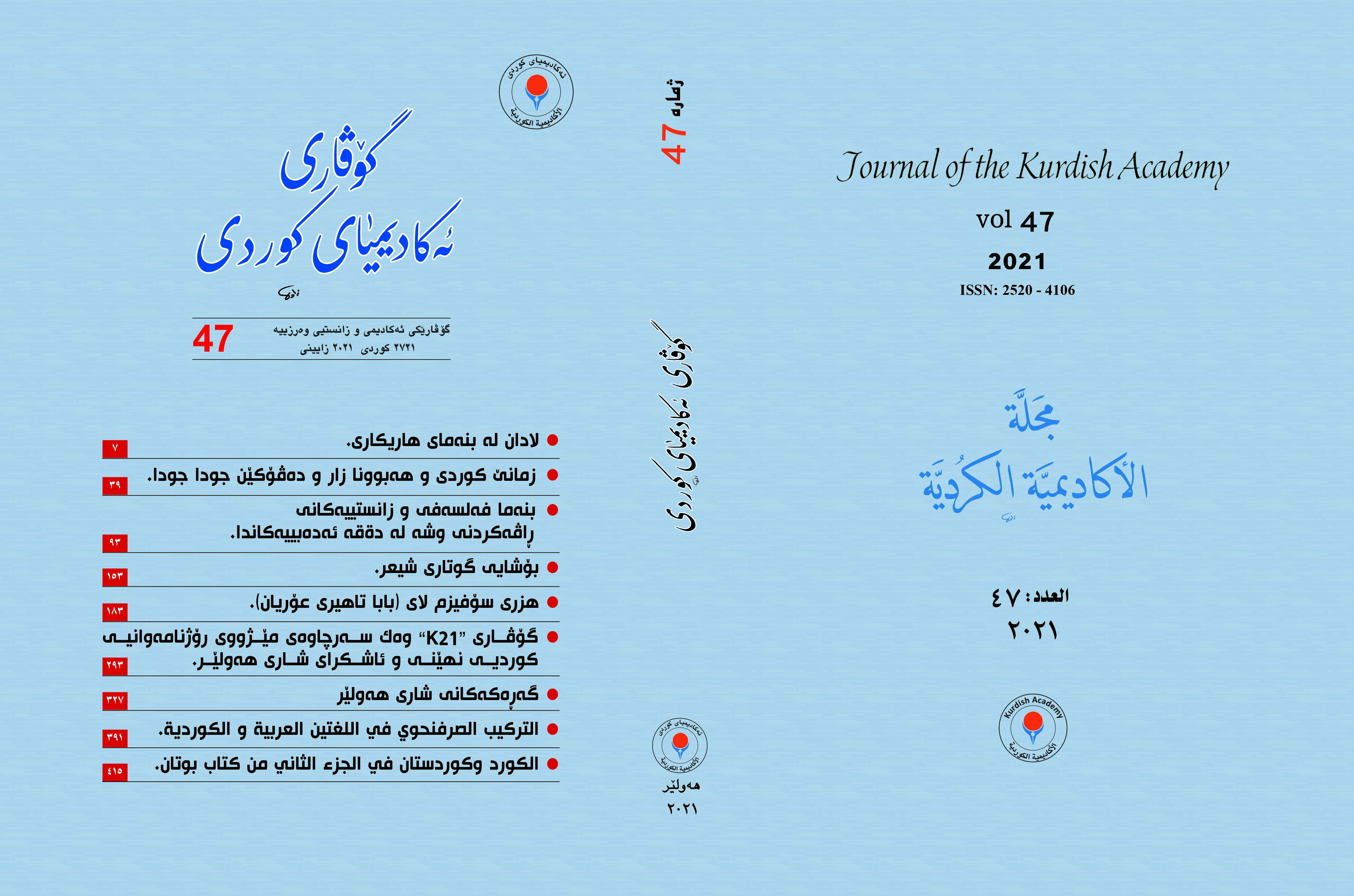
Journal Kurdish Academy

Journal of the Kurdish Academy

Vol. 0, No. 47 (2021)

Journal of the Kurdish Academy

15 June 2021 · 15 articles

Proceedings of
Advanced Knowledge

ئەرکێن زمانی د سترانێن کەنالێ (پێلستانک) دا

ژیمان سەبری نعمەت, عسمەت مەحموود محەمەد,

This study (The unctions of language in the songs of Pelistank TV), is an attempt to find out the functions of the language in the texts of Children songs of Pelistank TV. This study aims to discover the percentages of different functions of 31 chosen songs in order to uncover the effects of these songs on children. The study also strives to exposethe suitability of the chosen songs with the childhood age in order to know to how extend these songs have a conative function and to determine wheather the chosen songs have negative or positive functions on children.


Proceedings of
Advanced Knowledge

التركيب الصرفنحوي في اللغتين العربية و الكوردية

وریا عمر أمین,

There are three types of comparative language studies, where their objectives and  means differ.

  1 -  Historical Comparative Linguistics:  Comparing languages ​​with the aim of finding out the common origin from which a particular Language or  group of languages ​​have been descended to draw the linguistic family tree and identify the location of each language within the structure of the  family to which it belongs. i.e.  To identify  their  Genetic  relationship.

2 - Typological : The comparison of languages ​​in order to find out  the similarities and differences between languages ​​in their present form without any reference to their historical origins in order to formulate a general theory of the linguistic structure of the surface structure.  One of the main objectives of this approach is to classify languages ​​into groups that are similar or share one or more of their characteristics.

3 -  Contrastive analysis:  Comparing Languages to find the easiest way to teach other languages .

Genetically Arabic language belongs to the Semitic family of languages, Typologically is an VSO/SOV Polysynthetic  Fusional  Language.

Kurdish language belongs to the Indo-European language family.  Typologically it is an SOV, Agglutinative Polysynthetic Language.  

This research is a comparison between Kurdish and Arabic Languages  to identify the similarities and differences in their  system of  Personal Pronoun Suffixes  and Morphsyntactic Construction .   

Proceedings of
Advanced Knowledge

الكورد وكوردستان في الجزء الثاني من كتاب بوتان دراسة تاريخية طبوغرافية للمستشرق الالماني مارتين هارتمان

فرست زبیر محمد روژبەیانی,

This study is dedicated to research the second book of "Bothan" by the German Orientalist, Martin Hartman, was published during 1896- 1897. The book provides valuable information about the history and geography of the distinguished part of Kurdistan. Herein, we have investigated and analyzed the references used by the author, mostly undiscovered ones yet. This research is an analytical study to the second book ( the research about the first book was published earlier in this magazine). In the second part Hartman covers Mountains, Rivers and the inhabitants of "Jazira Bohtan". The references used by Hartman are specified to Assyrian, Syriac, Aramic, Greek, and Roman Latin up to the Islamic Geographists, and modern European Orientalists' sourses. Moreover, it provides a diagram about all those passed by the location of "Jazira Bohtan". Part of the study is specified to the analysis on the terminology of the "Kurds". Herein, Hartman investigated roots of the term and gives accurate information about what does the word "Kurd"mean and what are the sources that covered the subject, where and which areas acmmodate the land of Kurds. The research has answer to all those kind of questions.

Proceedings of
Advanced Knowledge

بنەما فەلسەفی و زانستییەكانی ڕاڤەكردنی وشە لە دەقە ئەدەبییەكاندا

ئەحمەد محەمەد مام عوسمان قەرەنی,

In defining vocabulary in literary texts, there are linguistic and cognitive contradictions. To explain this mismatch, the tenth grade Kurdish language and literature textbook has been used as an example, in which scientific and philosophical principles are ignored, the meaning of vocabulary is defined by giving dictionary meaning which don’t fit the concept. This research is made into two parts:

Part one involves theory, vocabulary is explained according philosophy of rhetoric and their meaning according to their literary contexts, they are also compared to linguistic theories, the role of the word in sentence composition has been analyzed.

   In part two, the conclusions of the first part has been applied to four texts of the mentioned textbook, their mistakes highlighted and corrected according the role of the words in cognition and linguistic contexts. At the end the most significant conclusions are presented.


Proceedings of
Advanced Knowledge

بۆشایی گوتاری شیعر لە دەقی)ئۆدیسیۆس نێرە یان مێیە؟(ی )ع. ع. یوسف( دا

غازی حەسەن

The research is about analyzing the gaps between the discourses of the poetic text of (Abbas Abdulla Yousf). This is a methodology based on the pragmatic theory, in particular the speech act, the analysis of the manner of creation of “gutter talk” in the discourse text in the manner of form and shape, or idea and image and imagination and thought, and explicit and implicit meaning. In this research, we have relied upon a group of linguistic codes that are related to the creation of gap (with purpose) and (out of purpose).

The discourse text is about carrying out an action, or more than an action for achieving a purpose. Gutter talk in the text is one of the actions of communication. The action has been created on purpose by the author of the text as a result of leaving gutter, or idea, image, and mental imagination, to move the reader and engage him/her in reproducing the text itself or completing the text (written or spoken).

The gaps could create a mental, philosophical, social meaning in a specific environment


Proceedings of
Advanced Knowledge

په‌یوه‌نديى واتایى ئاسۆیى و ستوونى له‌ شيعره‌كانى (له‌تیف هه‌ڵمه‌ت) دا

ئەژین ئیبراهیم ساڵح,

This research is in tatled as(Horizontai andverticalmeaning  relation in (Latif Halmat) poems, coming wordstogeter relation in the lines, in both horizontal and vertical level are clearly indicated.

The importance and reason of selection the research:

Meaning relations are semantic subjects, that include the relation are semantic subjects, that include  the relation of coming of language words together to convey  the perfect message and conclude dialogue action. Or harmonizing the language words together and repeationg innumberable in meaningful sentences.

The materoal and method of the research:

The research is adhered to descriptive method becauce the language of the poems is written in todays conversation language.

Regarding the research material,the poems of akurdish poet (Latef halmat) are used.

This research consists of two parts except introduction and conclusion:

In the first part, the concept, the definition of meaning relation , the types of meaning relation, and noun phenomenon are stated.

In the second part, meaning phenomenon in both vertical   and horizontal level in the poems are explained.


Proceedings of
Advanced Knowledge

پیشه‌ی جۆڵایی لای جووه‌كانی كوردستان

سازان سەباح پیرباڵ,

Weaving is considered one of the most important works and major professions practiced by Jews in Kurdistan, especially those who live in villages and rural areas, and this profession continued with them for several centuries and for several generations, keeping it, and that this profession was among the folkloric works among the people, and it had An important role in their acceptance among other people and in strengthening their social relationships.

In addition to that, this profession had an important role in the manufacture of used materials such as clothes, weaving chapels, local carpets, shawls and nets that were known in cities and countryside, in addition to that the profession of textile coloring (Khumji) was complementary to this profession, and the quality The beauty of the product was an important source of their revenue and that many of them were using it as a commodity for commercial purposes between cities and exported abroad.

The woman was more experienced to prepare the basic materials for this profession such as (sheep wool, yellow goat hair, silk fabric, cotton threads, metallic yarn), then the cleaning and washing phase began and the pendants removed from them, then the drying phase in a fresh place and in open air, then Analyzing and decoding yarn with a bale called (shana), meaning the comb, then comes the stage of real spinning with a bale called (tashi), and then comes the stage of choosing colors, and often for the purpose of making shells and nets that used the same colors as real or natural wool without coloring,The Jewish families who practice the profession of spinning (Jolla) had a lot of experience in the field of this profession, and next to them there were families who practiced the profession of coloring (Khomji) in a polite manner and they were known so that most of those who practice the profession of spinning send their products to them for the purpose of coloring for a small amount, after completion From the coloring, the owners of the profession of spinning seem to spin and weave these materials with a bale called (Pigalle).(Garogey Bouzy, Jajim, Frashi chnrawi Tinky Dewar, barmal, Kr, and Kilim) are among their most important products, which remain to this day and are present in many museums. From the folklore of their area, each of the Jewish families had a specific type of their own craft.

Proceedings of
Advanced Knowledge

زمانێ‌ كوردی و هه‌بوونا زار و ده‌ڤۆكێن جودا جودا

ئاشتی حه‌جی حه‌سه‌ن, بەدرەدین عەبدولكەریم قادر

Dialect is a set of linguistic qualities that belong to a particular environment, as it makes it easier for groups that speak different dialects and one language to communicate with each other, to understand the conversation between them as much as the bond that binds those dialects, and dialects vary in the manner of the pronunciation of certain words. it belongs to a group of people and distinguishes them from other groups.

   Akre dialect is one of the Kurdish dialects that belong to the Family of the Bahadinian dialects or the North Karmanji dialect, which is considered the largest and widest of the Kurdish dialects. it seems to certain people that Akre dialects are all the same, but in reality it contains many accent differences that people from the Kurdish linguists scholars can recognize them. Examples of these dialects are the Akreyi, the Zebari, the Sorchi, and the Harke. The differences in these dialects lie in the level of sound and meaning.

Proceedings of
Advanced Knowledge

ڕۆڵی خستنەسەر لە زاراوەسازیدا

میدیا مراد محه‌مه‌دئه‌مین

The paper which is entitled ”The role of addition in terminology” focuses on terminology and the role addition plays in forming terms in Kurdish. Addition is a means of forming noun phrase and this is useful in terminology as terms themselves are nouns.

The terms that are used in this way are dealt with as words or compound noun in their use and in dictionaries, but they differ in their structure, which is obvious in their field and method.

The methodology of the research is an analytic description of middle Kurdish dialect. The examples are takes from books, dictionaries, and also from terminological dictionaries related to this dialect.

The research is made of two parts besides the introduction and conclusion:

The first aspect is “Terminology” takes terms, definitions, processes of borrowing terms and the ways of forming terms.

The second aspect is entitled” The role of addition in terminology” this part focuses on the concept and definitions of the phrase addition similarities and differences between phrases and compound words, noun phrase addition and the term of addition, this part  focuses on the role of addition in terminology.

Finally, the conclusions arrived at are summarized in several points.

Proceedings of
Advanced Knowledge

گەڕەكەكانی شاری هەولێر لە سەرژمێرییە فەرمییەكانی رۆژگاری پاشایەتیدا (1947-1958)

دڵشاد مەحموود عەبدولڕەحمان,

This study highlights the developments witnessed by Erbil City Quarters in formal Iraqi statistics; the city, like other cities, had been making a slow progress during the last century of the Ottoman rule. Yet, it was influenced by the consequences of the First World War on the world in general and the region in particular.

Thus, the present study tackles the historical development of the city's neighborhoods in all their tow areas; the citadel, and citadel's immediate surroundings. Hence, it analyzes the city's official statistical data in different walks of life, the population and its distribution in the neighborhoods, the number of state and private institution therein, and the prevalent architectural modes. Depending on reliable sources, the study also explores the relation between the city's inhabitants, their lifestyles, values, and tradition, which shaped their lives during the aforementioned historical stage.


Proceedings of
Advanced Knowledge

گۆڤاری "K21" وەك سەرچاوەی مێژووی رۆژنامەوانیی كوردیی نهێنی و ئاشكرای شاری هەولێر

ئازاد عوبێد ساڵح,

This study deals with the role of K21 magazine in the history of the secret and public Kurdish press of Erbil, an important part of the history of Kurdish culture and journalism.

This study is looking for a collection of secret and public newspapers in both Kurdish and Arabic languages, the texts of which have been published on the pages of the aforementioned magazine, all of which were issued in the same city center or in its administrative borders. The newspapers are:

1-The Secretaries: (YeketîTecoshîn 1944), (Al-Kadir 1968-1969), (DengîPeshmarga1968-1969), and (AsoyKrekar 1989).

2-Publics: (Hetaw 1948), (Al-Thaqafa 1957-1958), (Zyan 1959), Rezne 1970-1971), (Roshinbîr 1973), (Yaxîbûn 1973), and(Kongra 1991).

There is no doubt that a large part of the content of these newspapers, the latest and the texts related to the history of Erbil and many of its writers from the people of Erbil, the codification is of great importance to the history of the city in particular and the history of the Kurds in general.


Proceedings of
Advanced Knowledge

لادان لە بنەمای هاریکاری (کتێبی ڕشتەی مرواری بە نموونە)

ئاگرین شەوكەت هادی, كه‌لسووم خالید ئه‌حمه‌د, نەریمان عەبدولڵا خۆشناو

1-The Title of the Paper

The paper is entitle Violation of the Principle of Cooperation in the "The Book of Rishaty Mirwari as an Example". It is a pragmatic study, which focuses on the best texts of this book to illustrate them based on the principles of cooperation. This study is an attempt to show the basic principles of cooperation in the written texts.

2-The Scope and Hypothesis of the Study

The research is conducted according to the pragmatic level. The examples are illustrates based on the Grice's principles of cooperation. The scope of the study is limited to only of the examples taken from this book ( Rishaty Mirwari). The research paper is conducted within descriptive analysis method.

3-The Purpose of the Study

One reason of choosing this topic for the study is the effect of the relation exists between speaker and listener, particularly within the principles of cooperation as through practicing these principles among individuals of community, it is very powerful in the success of this relation. So language is a social activity for the sake of cooperation among individuals, communication takes place.

4- The Problem of the Study

The paper is an attempt to a pragmatic analysis of some written texts in the book of Rishatay Mirwari according to the principles of cooperation. The problem was in the violations of the principles of cooperation in that each written text was violated by more than one principle; it is very difficult to find an example where there is only one violation of the principles.

5- The Content of the Study

The content of the study besides of the introduction and conclusions is comprised of three sections:

The first section is devoted to theoretical part, focuses on the Paul Grice's cooperative principles. It also mentions the main principles of cooperation such as maxims of quantity; maxims of quality, maxims of manner, and maxims of relevance with examples are provided for each of them.

The second section is also a theoretical part pays attention to the violations of Grice's cooperative principles with the illustrations of examples in maxims of quantity and quality. This includes some violations like (mocking, satire, pointing, exaggeration, over briefing) as well as the maxims of manner and relevance with necessary explanations about each of them.

The third section deals with the practical issues of the study. This part is about the violations of cooperative principles based on analyzing examples taken from the book of Rishtay Mirwari.

Finally, the conclusions, list of references, and the abstract are introduced in English and Arabic.


Proceedings of
Advanced Knowledge

هزر له‌ چیڕۆكه‌كانى (حه‌سه‌ن جاف) دا كۆمه‌ڵه‌ چیڕۆكى (دیجله‌ى تاوان) به‌نموونه‌

تەڵعەت محەمەد عەزیز, سەلیم ڕەشید ساڵح

This paper is titled (theme in stories written by Hassan Jaff, the collection of stories titled The Tigris of Crime (Dijlai Tawan) as a case study). Theme, as an important part in the components of a text, has an important and serious role in creating any text. Here, I tried to analyze theme of the stories applying analytical method and write down the most important types of these themes which are reflected in his stories and become a core material for his stories.

This paper consists of two parts. The first part consists of (theme as a theoretical point of view, theme as a term, theme in different texts, theme in Kurdish stories). In the second part, to better introduce theme in Kurdish stories, I select the collection stories of The Tigris Crime (Dijlai Tawan) by Hassan Jaff as a case study. This part is dedicated to discuss (theme for Hassan Jaff, thematically analyzation of stories of Hassan Jaff, political them, patriotic theme, mythical theme, symbolic theme).

I come conclusion that the writer being successful in dealing with various types of themes and that political theme has occupied vast area in wors. 


Proceedings of
Advanced Knowledge

هزر و بیرێن بەرگری د هۆزانێن (حاجی قادرێ كۆیی) دا

عەبدوڵلا یاسین عەلی ئامێدی, موحەمەد عومەر ئیبراهیم, هاوكار موحەمەد رەشید,

The idea of resistance occupied a distinctive place in the poetic product of the well-known poet (Haji Qadir), especially the use of this poetic purpose in a masterful, striking and appropriate manner. In order to clarify this, we discussed in this research some basic aspects related to this poetic line and an indication of the life conditions of the period in which the poet lived. Then he touched upon examples of his verses that included this idea.


Proceedings of
Advanced Knowledge

هزرى سۆفیزم لای (بابا تاهیری عۆریان)

ئارام قادر صابر, محەمەد جەودەت عومەر,

This paper is an indexical analysis reading in the depth of Sufi (mysticism) thought (hermeneutical analysis) in ((Baba taher Al-Auryani)). In this study, we focused on his sayings and poems, especially the quatrains and dualistic poems, and we also investigated the sources of his Sufi ideas, especially his relationship with the (Yarsan) sect and Islamic Sufis. Also, this research deals with Sufi thought and its stages, the philosophical and social vision and the unity of existence which is considered one of the Sufi trends, gratitude and union between God and the universe, and the paradoxes of ((Babataher Al-Aryani)), and how Babathar Al-Aryani expressed his vision in his words and poems. Sufi terminology and the way of the people of truth, especially the term of the heart, which was expressed in a ritualistic manner, and also referred to the importance of the status and value of man, and the revelation of God in man, with its reference to the social aspect of coexistence and knowledge of the truth in religion.