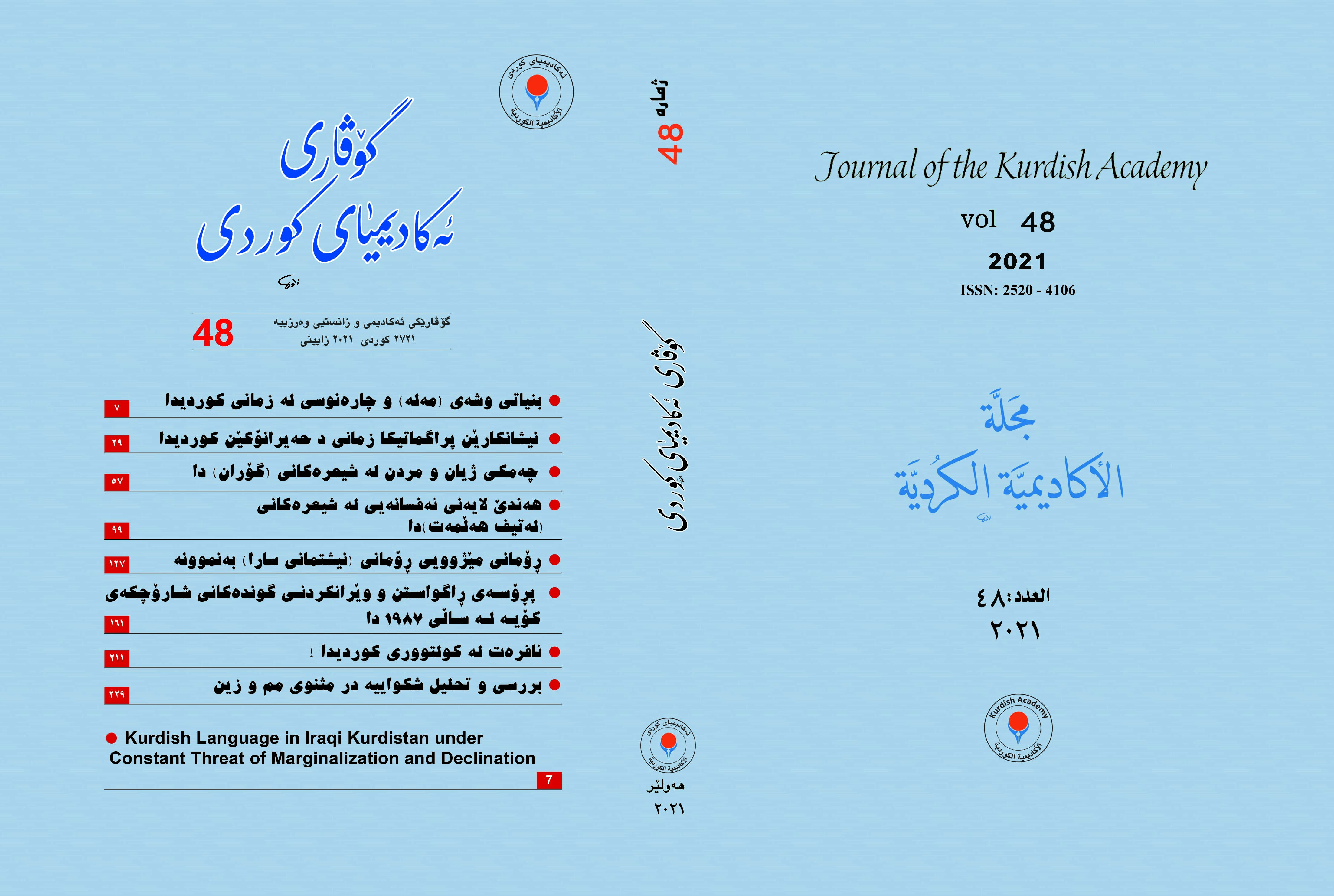
Journal Kurdish Academy

Journal of the Kurdish Academy

Vol. 0, No. 48 (2021)

Journal of the Kurdish Academy

15 September 2021 · 9 articles

Proceedings of
Advanced Knowledge

Kurdish Language in Iraqi Kurdistan under Constant Threat of Marginalization and Declination

Muhammad Qadir Saeed

The study on which this article is based demonstrates the critical situation of Kurdish language in Iraqi Kurdistan Region and warns the officials and the Kurdish academics of the threat of English which is one of the main factors of Kurdish language decline and marginalization in Iraqi Kurdistan where the process of resisting language shift is not as required. One of the major questions this study tries to answer could revolve around the role of English in putting aside the Kurdish language in Iraqi Kurdistan where private schools use English as the first language for their Kurdish students. Likewise, this paper tries to focus on other factors that result into the marginalization of Kurdish language in Iraqi Kurdistan and it aims at searching for the symptoms of language marginalization and declination? What should be done to resist the decline produced in language is one of the essential objectives beyond writing this research. Meanwhile, it tries to know the role of language policy (if there is any) towards Kurdish language? Since Kurdish language is under constant threat of marginalization and declination, any attempt to protect and revitalize it would contribute to revive the Kurdish language for future generation. Depending on a descriptive method, this study arrives at the fact that what has been done till now in terms of the threat of English and its domination which gradually marginalizes Kurdish language is not as required and it explores the ways to be taken to resist such a language threat.

Proceedings of
Advanced Knowledge

ئافرەت لە کولتووری کوردیدا !

ڕەشاد سەبری میران

This study takes an analytical approach to the social and cultural essences that divides men and women in the Kurdish society, the impact and outcomes of this social phenomenon on the life of Kurdish women and the general social inclinations within the Kurdish society; finally, outcomes and suggestions are presented which are supported by relevant theoretical resources and field observations of this phenomenon-;as the author is a member of the society analyzed.

This analytical study sheds light on the components of the Kurdish social system, the mechanism of its social establishments and the ways it works, how it organizes life and social relationships. This analytical study defines the Kurdish society as a patriarchal society; thus, the main factor of male dominance leading in due course to female alienation in the society and in particular, its human value ; the patriarchal values and their impacts on the Kurdish society led, to a large extent, hardship on the life of Kurdish women- difficult tasks are laden upon them and their liberties made limited ... in this study references are made to a number of Kurdish cultural values which have patriarchal connotations,  thus attempt is made to explore levels of their effects on the Kurdish women life.

Proceedings of
Advanced Knowledge

بررسی و تحلیل شکواییه در مثنوی مم و زین

جیهاد شکری رشید,

The Resisting and complaining poetry considered to be one of the oldest Lyrics type of poetry in the Kurdish Literature.It had a special space and had been supported in the Kurdish Literature in a way people started to addict this type of poems as it shown in the printed Divans and books.

Masnawi of Mam u Zin is one of these types of literature that carried a resisting and complaining flavor in which it affected the political, social and even the social dictionary of the Kurdish community.

This Research paper tends to use the Descriptive-Analytical method to analyze the Masnawi of Mam u Zin to show how Khani used the complaining poetry in his context.

The Result of this paper concludes the importance of Khani’s innovation of complaining poetry in Kurdish Literature in a way not to be criticized and how it does affect the social and political systems, so he accordingly brought innovation to the Kurdish Literature.

Proceedings of
Advanced Knowledge

بنیاتى وشەى (مەلە) و چارەنوسى لە زمانى کوردیدا

فاروق عومەر سدیق

Mala is one of the oldest Kurdish words that, throughout its long history, has fought for survival and has not allowed other words to shake its position.

The potential and significance of a word may vary. For example, the word can be a member of the semantic field “separation”, “transportation”, and “sports game”. Such semantic fields are not only found in Kurdish but in many other languages as well.

To date, no independent study has been conducted in Kurdish or other Iranian languages, to cover the semantic, lexical, morphological, and etymological aspects of the word Mala. Hence, we deemed it necessary to conduct the study which falls into an introduction and two parts in addition to the conclusions, and as follows:


Part one explores the semantic, lexical, and morphological characteristics of the words “mala” and “malakirdin” while part two examines the etymology of the word “mala”.


Proceedings of
Advanced Knowledge

پڕۆسەی ڕاگواستن و وێرانكردنی گوندەكانی شارۆچكەی كۆیە لە ساڵی 1987 دا

بورهان حاته‌م عوسمان

In 1987, a process of deportation and demolition of villages in southern Kurdistan was started by the Ba'ath government in Baghdad, and within the framework of this process, the villages of Koysinjaq district were demolished and their residents were deported. This research has touched on the deportation and demolition of 128 villages, based on unpublished official Iraqi documents. The research deals with the reasons for that operation and the plan of deportation and demolition in the three areas that made up the Quesanjaq district, namely (the district center, Shorsh sub-district and TaqTaq sub-district). The deportation and demolition process in 1987 of the aforementioned district’s villages are discussed in detail, which was carried out in two different stages: the first phase from April 20 to May 20, during which (42) villages were demolished. And the second phase, from May 21 to July 20, in which 86 villages were demolished. In another aspect of the research, the spotlight is shed on the cancellation of the Shorsh and TaqTaq sub-districts within the Koysinjaq district, and the proposals and decisions presented by government, security and military officials to demolish both areas, which were not implemented.

Proceedings of
Advanced Knowledge

چەمکی ژیان و مردن لە شیعرەکانی (گۆران) دا

جه‌بار ئه‌حمه‌د حسێن,

One of the most important topics, which is not only involved in poetry and literature, which also many of the fields of knowledge such as religion, philosophy and psychology have dealt with, is life and death. Goran, the poet, also raised this issue from his point of view in his poems. The purpose of this study is to identify this perspective through the analysis of his poems.

This study consists of three sections which are as follows: The first section addresses the meanings of life and death from a religious, philosophical and psychological point of view. The second section is about the identifying the aspects of life and the principles and foundations of a happy life, which are pointed out in Goran's poems. In the third section, through analysing his poems, Goran's view of the catastrophe of death, the types of death, the causes of death and the subject of immortality is stated. The most important results of the study are summarized in a few points.

Proceedings of
Advanced Knowledge

ڕۆمانى مێژوويى ڕۆمانى (نيشتمانى سارا) به‌نموونه‌

ئاواره‌ كه‌مال صالح,

This study is entitled (Historical novel, with reference to Sara’s Homeland as an example). is a practical analysis of the novel (Sara's Homeland) which is historical  novel the structure of which hinges upon history. Yet, This does not necessarily mean any treatment of the text as a history subject matter. Rather, the novelist here narrates the historical events and reshapes them in an artistic mode tinged with ideas and conceptions in his own mind, where the receiver / reader feels the pleasure of  the fiction.

the historical novel serves as a field for re-reading history more profoundly and an attempt to revive the dark and hidden aspects of history. Thus, we can connect past to the present time due consciousness. From this standpoint, the novel )Sara's Homeland) is an attempt to re-portray the events of the past century in Iraqi Kurdistan and calling history into question.


Proceedings of
Advanced Knowledge

نیشانكارێن پراگماتیكا زمانی د حه‌یرانۆكێن كوردیدا (گوڤه‌را به‌هدینی) وه‌ك نموونه‌

ئاشتی حه‌جی حه‌سه‌ن, زێره‌ڤان ئیبراهیم موسا,

The paper is entitled “Deixis in Kurdish Folk Songs ‘Hayranok‌: Taking Badini Area as an Example”. It is a pragmatic investigation applied to Kurdish folk songs commonly known as ‘Hayranok‌ in Kurdish. Deixis are important pillars in language study and pragmatics because of their important role in helping understanding everyday speech; they make the speech clearer and more comprehensible from the speaker to the listener. Deixis is an area of pragmatics and is widely used in Hayranoksin their various types. Therefore, in Kurdish folk songs, types of deixis in general and personal deixis like pronouns, in particular are more widely used. This is related to the fact that the Hayranok songs are recited in the form of dialogue as the lovers in Hayranok, express their love for each other in the form of dialogue.


Proceedings of
Advanced Knowledge

هه‌ندێ لایه‌نی ئه‌فسانه‌یی‌ له‌ شیعره‌كانی (له‌تیف هه‌ڵمه‌ت)دا

مەكنون محەمەدتاهیر میقداد, تەلعەت محەمەد عەزیز

Literature of any nation cannot develop without taking advantage of its own culture and folklore. Our culture and literary folklore are precious fortune which we have to preserve and treat carefully. The return of poets from the classical to modern epoch to deal with cultural and folklore was always aiming at new and modern innovations in their poems.

Kurds, like other nations, possess a rich folklore and literary heritage which reflect and portraythe living standards of Kurds. Within the parts of folklore, legend is an important branch that poets always use it to invent a new style and theme that can draw the attention of readers toward their poems, and via using legend and legendary symbols, poets propose their hidden messages.

The poet (Halmat) has successfully dealt with legends and has gotten benefit from their symbolic figures, which draw the attention of readers toward his works. In this way, he could convey his messages and express thoughts and create statics for his poems and add a mixedflavor of both modern and folklore literature to his poems. For this purpose, he has used many of legendary person, legendary creatures and legendary actions in his poems.