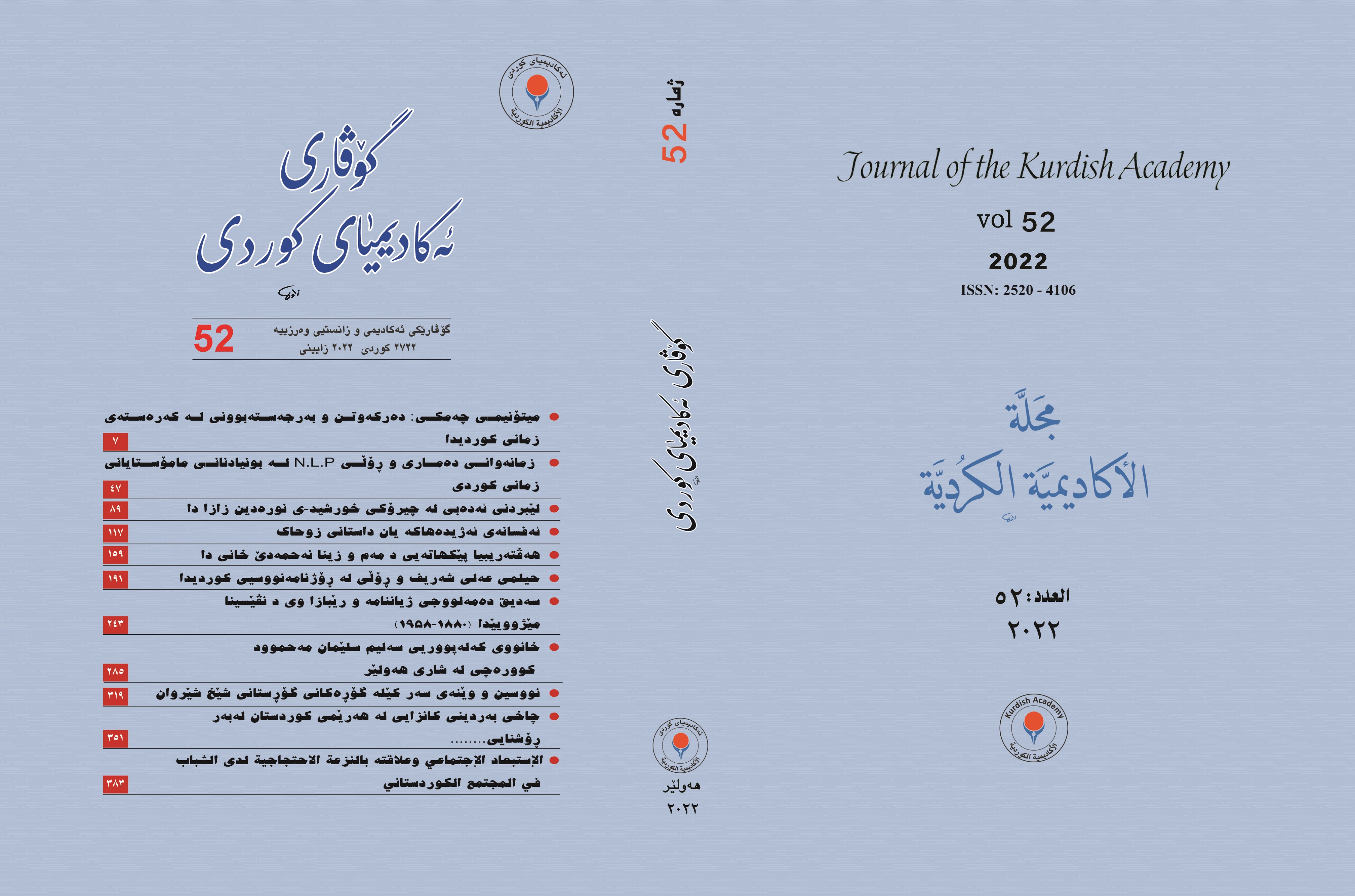
Journal Kurdish Academy

Journal of the Kurdish Academy

Vol. 0, No. 52 (2022)

Journal of the Kurdish Academy

11 October 2022 · 11 articles

Proceedings of
Advanced Knowledge

ئەفسانەی ئەژیدەهاکە یان داستانی زوحاک

فەرهاد عەزیز حەسەن

Myth, as a thoughtful, philosophical and linguistic work, has showed the world-view and beliefs of human throughout different historical eras and has developed and changed along with intellectual and philosophical evolution as well as the language use which has adapted itself to the mindset of that era. Myths in the literature world have been considered as main sources for different genres of literature, therefore, despite having undergone change and transformation within itself, it had taken other forms too. The epic of Kawa, the blacksmith, and Zuhhak is one of the oldest national epics which has emerged from ancient Kurdish literature, and finally connected to the historical stages of Kurdish nation, which is the fall of the Medes. The current research attempts to examine the evolution of the mentioned myth in the emergence of the type of epic and its relationship with the fall of the Medes and Kawa, the blacksmith, through depending on the analytical method of mythology and interpretation of historical evidences and ancient texts

Proceedings of
Advanced Knowledge

الإستبعاد الإجتماعي وعلاقته بالنزعة الاحتجاجية لدى الشباب في المجتمع الكوردستاني

عبدالحميد علي سعيد البرزنجي, صابر علي حسن الحريري,

Over the past three decades, the path of political and social life in the Kurdistan/Iraq region has been characterized specifically by the spread of the phenomenon of continuous and chronic social protests in all sectors and institutions, without developing into a broad and qualified movement: first, to raise the ceiling of demands to the political level, and secondly: the transition from local/sectoral protest to a cross-sectoral protest movement extending over a wider geographical area.

   This study aims to analyses the deep factors of this case and to monitor its most important indicators, which have become abnormal to many researchers given the rapid political transformations taking place locally, regionally and even internationally. This analytical study also seeks to provide a strategic systematic vision in a subject that has not yet received much research interest in our Kurdish academic and intellectual circles, namely, the relationship of social exclusion to the protests, although it has been addressed by Western and a few local research centers, through special insights and perceptions, However, it dealt with it in a fragmented way, methodically or sideways, and to a large extent subjective.

Proceedings of
Advanced Knowledge

چاخی به‌ردینی كانزایی له ‌هه‌رێمی كوردستان له‌به‌ر ڕۆشنایی پشكنینه‌ شوێنه‌وارییه‌كانی گردی سورێژه‌

هاوار نەجمەدین هەواس, نەعمان ئیبراهیم جومعه‌,

Prehistoric periods in Kurdistan region and in particular Chalcolithic Period, are rich for archeological sites. In this vein, some new archaeological sites have been discovered based on the conclusions gained from recent archeological excavations which historically belong to the aforementioned age.

One of the most important archeological sites is Surezha Hill (Grdi Surezha).  A very vivid image of human life could be portrayed in terms settlement and construction. Economic life could be realized after investigating the remains of plants and animal which can be considered as two important pillars of human food.

One of the other important tools for archaeologist to look for is by inspecting tools and necessities of human beings of that age to display how they lived on daily basis. In particular pottery remains has helped archaeologists to understand the settlements and qualities of civilization in those sites. Therefore, human inventions had paved the way for humans to start civilized life and thus led to the emergence of urban life.


Proceedings of
Advanced Knowledge

حیلمی عەلی شەریف و ڕۆڵی لە ڕۆژنامەنووسیی كوردیدا

نەورۆز یاسین محەمەد, ئەحمەد حەمەدئەمین ئۆمەر,

Writing academic research on the role of Hilmi Ali Sharif (1931-1988) in Kurdish journalism is of great importance due to the fact that he was worked in this field for four decades in the twentieth century and his fingerprints in the Kurdish journalism was very evident. Unfortunately, his role did not receive its due attention, and this is one of the reasons for choosing this topic.

This paper consists of an introduction, three sections, and a conclusion. In the first section, the origins of Hilmi Ali Sharifs’s family will be presented, then the stages of his childhood and adulthood and his private life will be shown.

In the second section, Helmy’s role in the field of journalism, especially his role in Xabat, Kurdistan, Al-Nour, and Hawkari newspapers discussed in the third section, the contents of Hilmi Ali Sharif’s writings and articles and the places of their publication, along with the names and pseudo names he used for publication are going to be documented and discussed. In the end, the most important conclusions and a list of references will be presented.


Proceedings of
Advanced Knowledge

خانووی کەلەپووريی سەلیم سلێمان مەحموود کوورەچی لە شاری هەولێر

عەبدولڵا خورشيد قادر, زياد ئەحمەد موحەممەد, جەمال جەميل ئەسعەد,

The house of (Salim Suleiman Al-Korji) is one of the heritage houses located in the locality of Saadonawa, south of the Erbil Citadel and the locality of Tajil. Its construction dates back to a period of time more than (100) years.

The house consists of one floor and includes three rectangular rooms with two iwans, a large courtyard, one stable, two bathrooms, a main entrance and a staircase.

As for the building materials used, they are bricks made of bricks, iron and wood, and plaster. In addition, the house is rich in terms of architectural and technical elements such as (iwans, arches), niches, niches, curtains, doors and windows, where the focus of the study was on the elements Architectural and technical for all sections of the house, with reference to the factors that affected the heritage house, including natural and human. At the end of the research, reference was made to the archaeological maintenance works, preservation and rehabilitation of the house.

Proceedings of
Advanced Knowledge

زمانەوانی دەماری و ڕۆڵی N.L.P لە بونیادنانی مامۆستایانی زمانی کوردی

ڕابەر فەرھاد حوسێن, عاطف عەبدوڵلا فەرهادی

This study is titled (Neurolinguistics and the Role of N.L.P in Rebuilding Kurdish-Language Teachers - Erbil schools as an Example); its aim and purpose is to improve teachers' abilities because teachers are considered the leaders of the nation, through whom the education sector develops and creates a generation of intellectuals, scientists, visionaries, and goals. All of them are in the service of revival and renaissance in the Kurdish community. This paper includes two parts. The first part talks about Neurolinguistics and some information about the human brain and the waves of the brain and both halves of the brain and then the mind.

 The second part talks about the role of the NLP in improving the skills and potentials of Kurdish language teachers, as well as the difference between the two teachers are explicitly shown. One of whom has experienced the NLP course, whereas the other one has no experience in the field. The individual's strategic plan is also discussed to further enhance the teachers' abilities. The methods of receiving information and strengthening the memory and focus are discussed. We will also talk about the process of exchanging information between teachers and students. This study falls within the frame of (Neurolinguistics and psycholinguistics), which is a part of the applied linguistic.

Proceedings of
Advanced Knowledge

سەدیق دەمەلووجی ژیاننامە و رێبازا وی د نڤێسینا مێژوویێدا (1880-1958)

بەردل عەبدولفەتاح عەلی, شێرزاد زەكەریا محەمەد

    Siddiq Al – Damluji is a well-known writer, intellectual and administrative personality in contemporary Iraq. Al-Damluji’s books and articles provided a great service to the history of Iraq in general and the history of the Kurds and Kurdistan in particular. The importance of his writings is due to the fact that he was a witness to the historical events he wrote about, but it seems that his writings about the Kurds did not satisfy the hardline Arab nationalists.  Al-Damluji and his writings remained far from research, this was one of the reasons to write this research about him and his method of writing history.

  This research is an attempt to shed light on Siddiq Ai-Damluji’s life as an administrator, historian, a journalist, and his attitudes towards the Ottoman state and the British Occupation of Iraq. This research relied on Al-Damluji’s main historical writings with a reference to its importance, and the main ideas and analyses it contained.

Proceedings of
Advanced Knowledge

لێبردنی ئەدەبی لە چیرۆكی خورشید-ی نورەدین زازا دا

بوشرا قادر كاكە محەمەد,

This paper is entitled “Plagiarism in The Story of Khurshid by Noordin Zaza”. we worked on the story of Khurshid by Noordin Zaza. Firstly we have explained the concept and terminology of (plagiarism/literary theft), and then within the framework of literary theories we pointed out similar and closely related terms about plagiarism including “citation, comparative literature, intertextuality, incorporation, translation, and mimicry” each of which gives different meaning about plagiarism, as for plagiarism is when an author commit literary theft by unauthorized use or close imitation of the language and thoughts of another author and the representation of them as one's own original work without referring to the source which it has been copied from. From this perspective, we worked on the story of “Khurshid” by Noordin Zaza which has been taken from Bjørnstjerne Bjørnson’s story “The Father” without any reference to it. We set the two texts or stories side by side and compared them along with translating the original text into the Kurdish language and placing both texts at the end of the paper.

In addition, we showed for what purpose and to which extent the altering has been done. We also used the comparative method in the paper.

Proceedings of
Advanced Knowledge

میتۆنیمی چەمکی: دەرکەوتن و بەرجەستەبوونی لە کەرەستەی زمانی کوردیدا

هۆشەنگ فارووق جەواد

This study explores metonyms as a conceptual phenomenon within the framework of cognitive linguistics. As is known, metonyms have been studied since antiquity, yet this study brings it under a cognitively oriented investigation highlighting some of its major aspects such as its properties, its difference with synecdoche, its distinction with metaphor, its types as well as a brief summary of Kövesces and Radden’s theory of metonymy (1998) which is currently seen as the most significant theory accounting for conceptual metonymy.

The study has been divided into seven sections. The prelude introduces the purpose of the study, the research questions, the methodology and the data of the study while the first section sheds light on the definition and the significance of metonymy. Moreover, the second and the third section are devoted to a survey of conceptual metonymy within the traditional school of linguistics and cognitive linguistics respectively. Section four is designed to distinguish between conceptual metaphor and conceptual metonymy within the cognitive framework. The fifth and sixth sections are mainly intended to deal with the types of conceptual metonymy and some different metonymical phenomena and the last section presents a brief overview of Kövesces and Radden’s theory of metonymy in terms of conceptual metonymy types and their manifestations in Kurdish language.

Proceedings of
Advanced Knowledge

نووسین و وێنەی سەر کێلە گۆڕەکانی گۆڕستانی شێخ شێروان

زیاد ئەحمەد موحەممەد,

The cemetery of Sheikh Shirwan, or what is called also the cemetery of Sheikh Jami, is located near the village of Sheikh Shirwan, to the southwest of the city of Erbil, 32 km away. The cemetery dates back to the 12th century AH / 16 AD, through the inscriptions of the grave of a person called Darwish Abdullah al-Andalusi, who died in 1114 AH / 1694 AD, while the oldest tombstone dates back to 1282 AH.

This study is based on reading and analyzing the inscriptions and pictures engraved on the tombstones that were not previously published. The tombstones contain writings that include the name, month and year of the death of the deceased person, with some phrases that indicate supplication, as well as the verses of poetry that the slave seeks to draw closer to his Lord. And among the most famous written poetic verses are two verses from the poetry of Imam Ali and Imam Shafi’i, all written in Arabic, specifically in the thuluth script.

Also, some of these tombstones contain intricate and simple engraved images by the maker of the evidence represented by weapons and war machines such as the pistol and dagger with a gunpowder purse and a scope for carrying weapons, hence the importance of research in studying and analyzing the images and writings on them.


Proceedings of
Advanced Knowledge

هەڤتەریبیا پێكهاتەیی د مەم و زینا ئەحمەدێ‌ خانی دا

عصمەت مەحمود محەمەد, مەسعود جەمیل رەشید,

Parallelism, as a poetic and rhythmic device in literary text, has been widely used in Kurdish literature. Despite its connection to poetry, the earliest research on this term was related to religious texts. Put it differently, parallelism exist in various discourses in order to add aesthetics to the language and has effects on the readers. Ahmed-i Khani is one of the Kurdish poets that mainly depended on this technique especially in his masterpiece (Men u Zin).

 Parallelism played a fundamental role in the aforementioned work and it became an essential device to build its poetic language. This research entitled (The synthetic parallelism in Ahmed-i Knani’s Mem u Zin) aims to specify and analyze the role and the types of synthetic parallelism in the (Mem u zin) of Ahmed-i Khani. The research Consists of two parts, the first part focuses on the theoretical framework, containing short history, terminology, definitions and the typology of parallelism. The second part is a statistic and analytic work on the different types of synthetic parallelism in the abovementioned literary work.