Journal Kurdish Academy

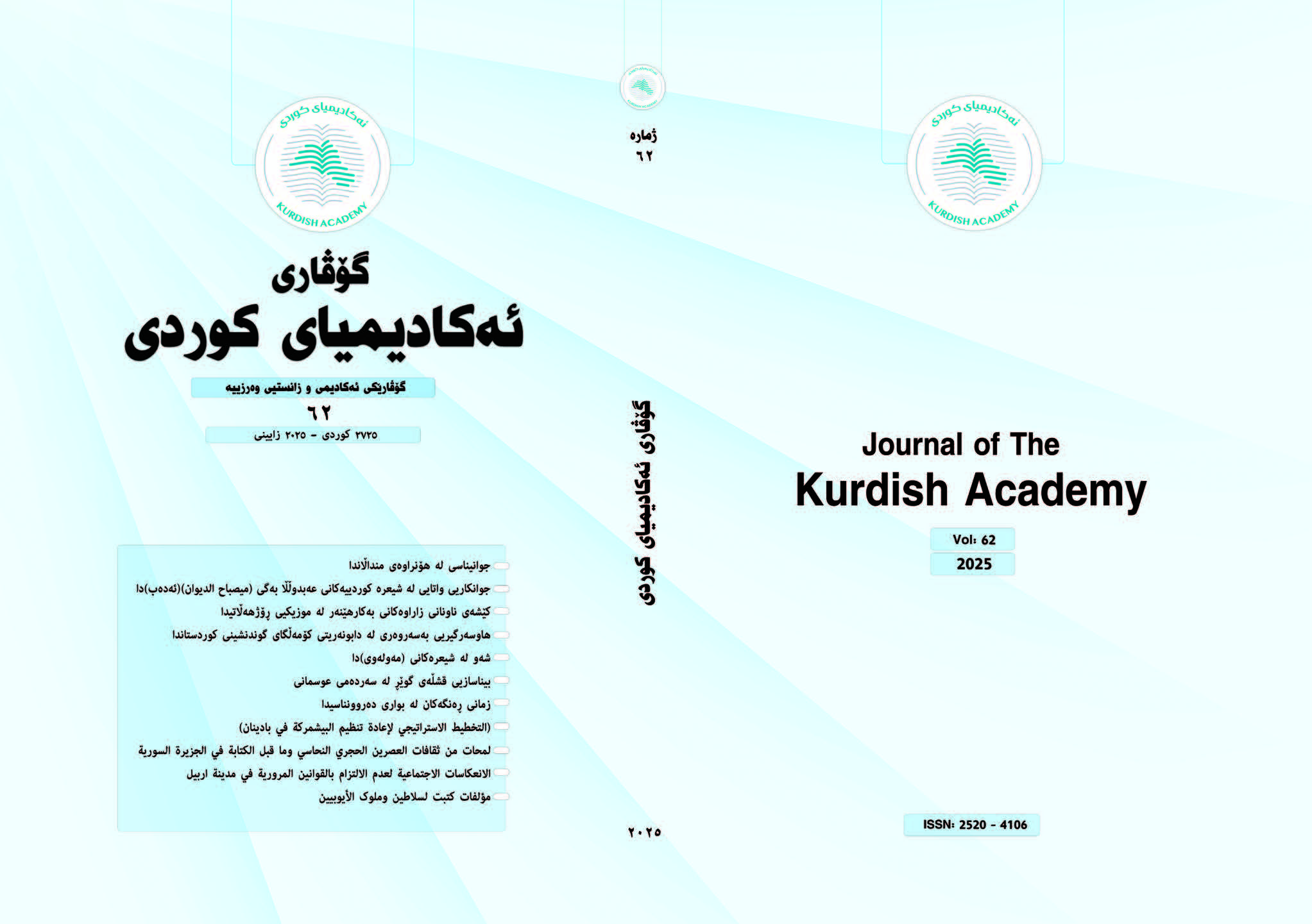
Journal of the Kurdish Academy

Vol. 1, No. 62 (2025)

Journal of the Kurdish Academy

25 May 2025 · 11 articles

Proceedings of
Advanced Knowledge

الانعاكسات الاجتماعية لعدم الالتزام بالقوانين المرورية في مدينة أربيل

omeed qader, أ. د. عبدالحمید علی سعید البرزنجی,

Abstract:

The role of social relations in implementing traffic law in Erbil city – a theoretical analytical study.

This research aims to know: the role of social relations in implementing traffic laws, and to identify the pattern of social relations in implementing traffic laws and instructions, as well as to identify the most important direct and indirect factors in social relations in implementing traffic laws in the city of Erbil.

The researcher used the descriptive analytical approach, using the field survey method on a random sample of vehicle drivers in the city of Erbil. The statistical data was collected from the available sources in the Erbil Traffic Directorate.

The researcher reached a number of conclusions that the negative relationships of road users in general and vehicle drivers in particular, have a major and major role in the non-compliance with traffic laws and instructions, and at high rate among young males with interests and influence, as well as the role of the mobile phone as one of the means of social communication in the occurrence of many traffic accidents in the city of Erbil.

Most traffic accidents occur during the day than at night, and in sunny weather for most of the four years from (2020 to 2023), the highest percentage of accidents (%93.36) was in the year (2021), and this attributed to the strength of social relations and the desire of individuals and groups to make these visits to each other.

The percentage and number of traffic accidents on external roads are higher than inside the city, as a result of the dominant social and tribal relations in these districts areas and villages, and their great lack of interest in traffic rules and instructions and their lack of concern for them.

Keywords :( Relations, Social Relations, the Traffic, Traffic Laws, Traffic Accidents).


Proceedings of
Advanced Knowledge

(التخطيط الاستراتيجي لإعادة تنظيم البيشمركة في بادينان) (فترة ما بين حملة الأنفال 1988 وانتفاضة 1991)

hiyam haji

This research is part of a forthcoming book that examines Kurdish resistance in Badinan after the Anfal campaign, focusing on 1988–1991. During this period, Kurdish regions faced intense military repression and systematic destruction, severely impacting infrastructure and communities, posing significant challenges for the Peshmerga. Despite these conditions, the Peshmerga successfully reorganized using advanced military strategies, including restructuring combat units, relocating headquarters based on security conditions, and strengthening secret communication networks to ensure safe information exchange. Cooperation between the Peshmerga and the Kurdistan Front fostered a collective approach, enhancing operational coordination and resource-sharing to sustain resistance.

With the outbreak of the Second Gulf War in 1990, the weakening of the Iraqi regime due to international sanctions provided the Kurdish resistance with a strategic opportunity. The Kurdistan Front intensified diplomatic efforts with regional and international powers to secure political and military support. Meanwhile, in Badinan, underground organizations were restructured despite strict government surveillance. Kurdish leaders employed sophisticated concealment tactics to maintain secrecy and coordinate with the Peshmerga. The March 1991 uprising marked a crucial turning point, bringing military gains and significant political advancements that reinforced Kurdish national rights within their ongoing struggle

Proceedings of
Advanced Knowledge

بيناسازیی قشڵەی گوێڕ لە سەردەمى عوسمانی (لێکۆڵینەوەیەکی شوێنەواری بیناسازییە)

Hussein Hasan

Abstract:

      One of the most important eras in Islamic history is thought to have been the Ottoman Empire. This significance stems from both the developments in architecture and the application of Islamic Sharia and striving in the name of God also, in terms of architecture, they have made very important and advanced steps. Qishla architecture was one of the most well-known architectural styles to develop in the late Ottoman era. These qishlas were founded in a number of places in Iraq, including Baghdad, Kirkuk, Erbil, Makhmour, Qushtapa, and Gwer. These Construction buildings built to keep them safe from bandits and thieves, these qishlas were mostly constructed in key spots along important public and commercial routes. They also oversaw these regions for military and administrative reasons. When soldiers were moving from one site to another, the qishlas offered them and their horses a place to rest for a short time before continuing on their journey. Thus, it can be claimed that qishlas were extremely helpful and utilized for both military and administrative objectives.

Keywords: Qishla, Gwer, Qishla plan, Military Architecure and Architectural elements

Proceedings of
Advanced Knowledge

جوانكاری واتایی له‌ شیعره‌ كوردییه‌كانی عه‌بدوڵڵا به‌گی میصباح الدیوان(ئه‌ده‌ب)دا.

عەلی تۆفیق

Literature is a significant and integral part of the culture and identity of nations. It is the mirror of life. Thus, the importance of literature should be taken into consideration in the present time and in the future. Rhetoric language is a key element of classic poets in general and of (Adab) in particular. For it is unusual for a poem not to have an art of aesthetics. This thesis titled ‘Semantic Aesthetics in the Kurdish Poems of Abdulla Bag Misbah Adab’ since there has not been any particular research on the topic. This research is divided into two main parts:

First part is theoretical that deals with the terms and concepts of rhetoric language. It also briefly discusses other branches of rhetoric language. Then it discusses word aesthetics and semantic aesthetics.

Second part is practical that consists of fourteen subtopics and deals with arts of semantic aesthetics in the poems of the poet.

Finally, the research ends with the results in several points, references, and the abstract in Arabic and English languages.

Proceedings of
Advanced Knowledge

جوانیناسی لە هۆنراوەی منداڵاندا

karwan ali, salar husaen, zhelwan baper

Literature, especially children's literature, leaves a positive impact on raising children, and is a major factor so that the child can express himself and speak correctly. This process reflects the logic of rhetoric and dialogue until it reaches the truth that the child pronounces these things easily and clearly, including: recognizing the meaning of sentences and their gestures and thinking about the philosophy of these gestures and searching for them. Children's poetry is able to develop and educate the child from its many educational and civilizational outlets. The musical, melodious steps of children's poetry develop the feeling of education and his aesthetic vision, and his desire to comprehend concepts and make this being willing to feel the beauty and impudence of life. The philosophy of children's poetry prepares the child psychologically so that he can contemplate and make a decision in facing life and its components, and the contemplative and deductive philosophy enables him to change the child's vision of his social environment positively, as it leaves an effective impact, so that he decides mentally without making mistakes and does not see the world from one angle. Therefore, the poem left a psychological and mental impact on the child's vision because children's poetry is one of the most beautiful literary types in children's literature. Through which the child realizes the beauty of expression and many outlets open up before him to purify his thinking from impurities and that the poem, apart from the musical melody, expressive aesthetics and philosophical starting points, carries within it other goals...

Proceedings of
Advanced Knowledge

زمانی ڕەنگەکان لە بواری دەروونناسیدا، توێژینەوەیەکی وەسفیی شیکارییە

عبد الستار أليخان, پ. هـ. م. كاوە طاهر ضاهر,

Abstra:

The study explores the complex relationships between color and mental processes, highlighting how the language of color influences emotions, behavior, and cognitive outcomes. Based on both empirical research and theoretical frameworks, this paper investigates relative universal and cultural interpretations of color in psychological contexts.

-Summary of Research Focus: The research primarily investigates how different colors elicit specific emotional and cognitive responses, as well as their role in therapeutic settings, educational practices, and intercultural communication. Previous studieshave proved that colors affect mental functioning by affecting mood, attention and memory. However, this study extends previous work by integrating cultural variations and their significance in the psychology of color.

 -Key findings and contributions: The findings reveal that while certain colors (e.g., red and blue) evoke universal emotional responses . Cultural contexts significantly shape the interpretation and emotional impact of others. Additionally, the study highlights the potential of color therapy in the management of anxiety and depression, in line with earlier research on chromotherapy. The contributions of this paper include a comprehensive framework for understanding color-emotion relations and their implications for applied psychology, marketing, and cross-cultural studies.

Keywords: Color psychology, emotional associations, cognitive responses, cultural interpretations, color symbolism.

Proceedings of
Advanced Knowledge

شه‌و له‌ شیعره‌کانی(مه‌وله‌وی)دا

سروشت حوێز, لوقمان ڕه‌ئوف

Summary

Night in Mawlawi's Poems

   Night in classical and romantic Kurdish poetry is a wide window through which poets look out onto a world full of contemplations and feelings. Night was a symbol of inspiration and isolation, and a mirror that reflects different human feelings, from sadness and longing to hope and tranquility. One of the reasons that prove the value of poetry is its words, so the words in the text constitute a strong factor in giving the poet meaning through signs and connotations. This research deals with the word (night) in Mawlawi's poems, with the aim of revealing the meanings and connotations of (night) in Mawlawi's texts, then defining the effect of night on the poet and how this is reflected in his poems. The research also deals with the topic of (night) in the poet's poetry. It also presents the role of night in the poet's poems in terms of meaning, influence and effectiveness. In the texts, it has often produced new meanings in contexts, in addition to working on the role and function of the word and its use in different meanings in the text. This is done by following the descriptive and analytical approach, to clarify the meanings of night in the poet's poems. This research consists of two parts. The first part deals with the concept of night, its definition, the importance of night in the poet’s poems, the reasons for describing night, comparing it to its type and how. The second part talks about the uses and meanings of different words such as (night meeting, worship and forgiveness, worry and sadness, danger, love, etc.)

Keywords: night, meeting, poet, pain, love.

Proceedings of
Advanced Knowledge

كێشەی ناونانی زاراوەکانی بەکارهێنەر لە موزیکیی ڕۆژهەڵاتیدا

عادل محەمەد کەریم کەریم, پ. ی. د. چیایی كمال سعدی,

This research explores the challenges surrounding terminology related to sound levels, scales, and modes in Eastern music, with a particular focus on the Kurdish language. The researcher highlights the inconsistency and diversity in musical terms such as sound levels, tetrachords, scales, and modes, as used by Kurdish communities and neighboring nations, including Arabs, Persians, and Turks.

The study is divided into two main sections:

  1. Introduction and Methodology: This section outlines the research objectives, procedures, and definitions of key terms central to the study.
  2. Key Discussions:

Discussion 1: Variability in Terminology for Tones, Scales, and Modes: The researcher examines the diverse nomenclature found in various sources, focusing on terms related to ranks, tetrachords, scales, and modes.

Discussion 2: Classification of Tetrachords, Scales, and Modes: This section provides a systematic classification based on two foundational pages—Ajam and right—along with their derivatives.

The thesis concludes with findings and recommendations aimed at advancing the understanding and development of terminology in Eastern music

Proceedings of
Advanced Knowledge

لمحات من ثقافات العصرين الحجري النحاسي وما قبل الكتابة في الجزيرة السورية " تل براك أنموذجا"

عمر شريف, أ. د. نعمان جمعة إبراهيم,

The Syrian Al-Jazeera region is one of the important regions in northern Mesopotamia, rich in its cultural heritage. Many mounds and archaeological sites are distributed across its land, dating back to different civilizational eras, whose archaeological features still remain today and need to be studied and excavated. Among these mounds is Tell Brak, which is one of the largest early urban centers in Western Kurdistan, and an ancient settlement dating back to prehistoric times. The site has gained great importance due to its historical and cultural depth for human civilization. Archaeological discoveries indicate that the site has witnessed cultural practices since the fifth millennium BC, especially the Halaf and Ubaid cultures, and a remarkable progress in the technology and development of stone tools and pottery industries. By the fourth millennium BC, the beginnings of the development of architecture and buildings appeared, as indicated by the discovery of the remains of its building plans and walls. Tell Brak expanded until it became a large city and an important urban center for the interaction of different cultures with the civilizational sites in southern Mesopotamia. These indications point to the important status of Tell Brak and the flourishing of economic and social activities and the crystallization of ideas, beliefs and other cultural practices related to spiritual life since the Chalcolithic and pre-literate eras.

Proceedings of
Advanced Knowledge

مؤلفات كتبت لسلاطين وملوك الأيوبيين

alulav77 Salem,

The Ayyubid Era was marked by a flourishing of military, political, cultural, and scientific achievements. During their reign, the cities of Egypt, the Levant, and the Arabian Peninsula became vibrant centers of intellectuals and scientific activity. Scholars, thinkers, and historians from various fields gathered in these cities, producing a wealth of literature that reflected the intellectual vigor of the period. Many of these works were dedicated to Ayyubid rulers, often focusing on topics such as politics, medicine, history, and literature. Purposes behind these writings varied significantly among scholars and author: for example, Many scholars aimed to gain the favor of Ayyubid rulers by dedicating their works to them. This often served as a means to secure royal patronage, prestigious positions, or financial rewards, other authors sought to spread their ideas and intellectual contributions. Some writings were directed specifically at offering sultans moral and administrative advice.

‏This study aims to explore these writings in depth, analyzing their themes, purposes, and the extent of royal patronage. Writers often emerged from professions tied to governance, justice, healthcare, poetry, or religion. These individuals not only contributed to the functioning of the state but also held significant cultural and societal influence, as the nation placed great importance on their expertise and contributions. This dynamic reflects the level of civilization and progress.

Proceedings of
Advanced Knowledge

هاوسەرگیریی بەسەروەری لە دابونەریتی کۆمەڵگای گوندنشینی کوردستاندا

حبیب مصطفی ابراهیم, پ.ی.د رضوان شریف صالح,

Abstract:

Manus marriage is characterized by the dominance and decision-making of the husband in the relationship between husband and wife within the family. The main purpose of this study is to present and explain the position of customs and traditions in ancient Kurdish society regarding this type of marriage, in a society where patriarchy authority was the mental basis of family formation. For this purpose, this study worked to introduce the nature of the relationship between husband and wife in terms of customs and traditions of a number of villages in the Kurdistan Region, to find out whether manus marriage existed in the 1960s in Kurdistan village society. This research mainly relies on analytical method, and field method. By observing the characteristics of the nature of Manus marriage in terms of male domination, the status of women and their deprivation of property rights in marriage, we found that Manus marriage existed in tribal societies in Kurdistan, which stemmed from patriarchal culture at that time.

Keywords : Marriage, Culture, Power ,Rights, Rituals.